


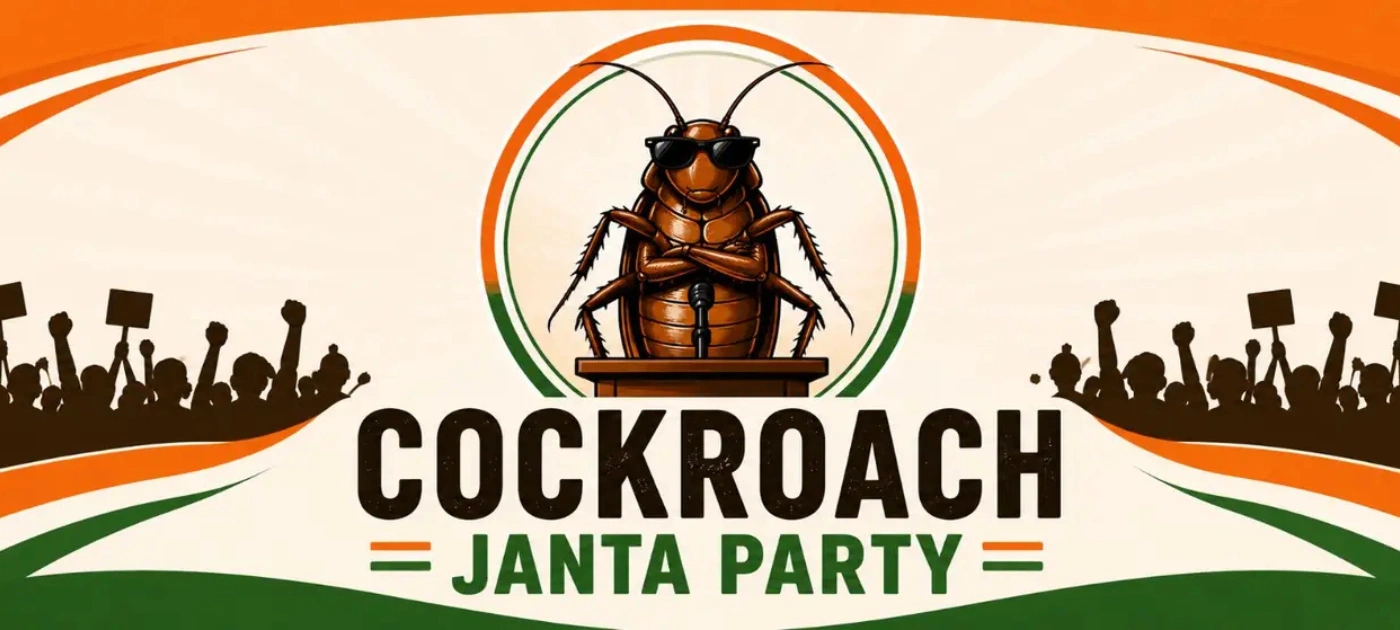


On May 15, Chief Justice of India Surya Kant made remarks during a Supreme Court hearing that were widely interpreted as calling unemployed, RTI-filing youth “cockroaches.” He later clarified that his statement was directed at those who use fake degrees to enter professions, not at unemployed youth in general. The clarification came too late. Within hours of the original remarks, Abhijeet Dipke, a 30-year-old former AAP social media volunteer, had already launched the Cockroach Janta Party.
The numbers that follow are worth reading slowly. 25,000 members in 48 hours. 1 lakh signups within three days. 4.2 lakh followers on Instagram and 80,000 on X by May 19. By May 20, the account had reached 3.5 million followers on Instagram and 83,000 on X.
The audience breakdown tells its own story. 96.5% of CJP’s followers are based in India, 76.7% are male, and 87.8% fall in the 18 to 34 age group, according to Creator Index data sourced from CultureX. This is not a Gen Z protest movement in the way most coverage has framed it. It is a platform built almost entirely on millennial men in their prime working years, exactly the demographic that has the most to say about employment, institutions, and being called a cockroach by a judge.
Trinamool Congress MPs Mahua Moitra and Kirti Azad publicly posted that they wanted to join. A few other counter-parties like the Indian National Cockroaches and the National Parasitic Front, formed within days to oppose it. Dipke said he did not expect this.
He did not launch a party, he launched a brand
Strip away the political framing and look at what Dipke actually did. He found a cultural flashpoint, a statement from the country’s top judge that made millions of young people feel seen and mocked at the same time. He created a shareable identity around it. “Main Bhi Cockroach” is not a slogan, but a membership card. It gives people something to post, something to claim, something to belong to.
Then he built infrastructure around it: a website, a manifesto, an election symbol, and a formal membership process. In creator economy terms, this is the equivalent of launching a newsletter, a merch line, and a Discord server in the same weekend.
The distribution was zero-budget with no paid ads, PR agency, or press outreach.
The engagement data makes the case. CJP’s top eight reels averaged 3.4 million views each and the account is sitting at a 5.237% engagement rate as of May 20, according to Creator Index data from CultureX. To put that in context, the Kofluence 2026 influencer marketing report found that even Tier 3 and Tier 4 creators, who consistently outperform metro influencers, average between 4.5% and 5.5% engagement. CJP, with 3.5 million followers, is matching that rate. Most accounts at that scale sit well below 2%.


This is the playbook that brand strategists charge crores to execute. Dipke ran it in under 48 hours, from Boston, on his own.
He learned this inside a political party and that is the real story
From 2020 to 2023, Abhijeet Dipke worked as a social media volunteer for AAP. He was not a politician, but on the content side, learning what travels, what builds community, and how a message gets shaped for a platform. He spent three years watching how social media machinery works when it is running at scale, for someone else’s brand.
When he left and eventually applied that knowledge to his own idea, the results came immediately. That is what happens when someone with real platform knowledge stops working for an institution and starts working for themselves.
This pattern is showing up everywhere right now. Vanshika Khurana spent years as an analyst at JP Morgan. She left in September 2025, after her fitness content on Instagram crossed 1 million followers, and built her audience to 1.8 million within a year of going full-time. She did not leave to become a creator, she already was one.
The common thread between Dipke and Khurana is that they both spent time inside large institutions, learned how things actually work, and then used that knowledge for themselves. Dipke learned virality from a political party, while Khurana learned discipline and credibility from investment banking, and both turned institutional knowledge into independent audiences.
The question worth asking is how many other people are sitting inside agencies, brands, newsrooms, and political parties right now, doing exactly what Dipke was doing at AAP: running someone else’s content machine, building someone else’s following, and learning everything they need to eventually go solo.
Then a counter-party showed up and it explained everything
Within days of CJP going viral, opposition parties formed. The stated purpose was to oppose the satirical outfit. But in creator economy terms, what actually happened is textbook: a format worked, so someone else copied it.
This happens constantly in the creator economy. One creator builds a niche, the format gets proven, and within weeks there are five more accounts doing the same thing. It happens with finance creators, fitness creators, dark humour pages. The moment something demonstrates reach, the space gets crowded. CJP demonstrated reach at a scale most creators never see, and the counter-movement formed almost immediately.
The speed of that duplication tells you something important about where India’s social media is right now. The Indian National Cockroaches is not the only counter-account to have emerged. A format can be born, validated, and cloned within a single week. That is how fast things move, and it is the same dynamic that makes building a defensible creator brand harder than it looks.
What this actually means
The Cockroach Janta Party will probably not become a registered political party. It has already done the more valuable thing: it proved that a single person with social media knowledge, the right moment, and zero budget can build a community of millions faster than most funded campaigns ever do.
The tools that built India’s creator economy, things like community identity, viral packaging, and platform-native content, are now being used to build things that have nothing to do with brand deals or follower counts. Political movements, fitness brands, finance channels, satirical parties. The underlying mechanics are identical.
The people who understand those mechanics are currently the most effective organizers, communicators, and community builders in the country. Some of them are working for brands. Some are working for politicians. Some, like Dipke and Khurana, are working for themselves.
The ones who go independent tend to move very fast once they do.