





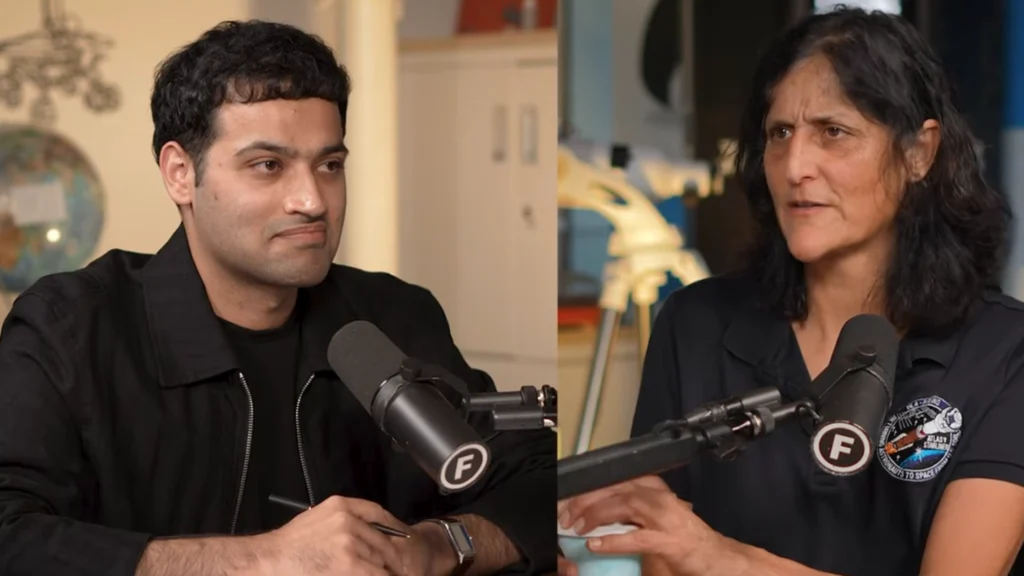
What does India look like from space? Not from a satellite image or a textbook diagram, but through the eyes of someone who has lived hundreds of kilometres above Earth for months at a time.
In Raj Shamani’s latest podcast episode, NASA Astronaut (Ret.) and U.S. Navy Captain (Ret.) Sunita ‘Suni’ Williams offers a rare, deeply human perspective on life in orbit. This isn’t just a conversation about rockets and science. It’s about emotion, isolation, wonder, and how distance reshapes love for home.
From watching the Himalayas rise like a spine across the planet to crying in zero gravity, Sunita’s stories make space feel both extraordinary and intimate.
Also read: Deepinder Goyal Appears on Raj Shamani’s Podcast Wearing a Mysterious Device
India from orbit: A living map of colour and light
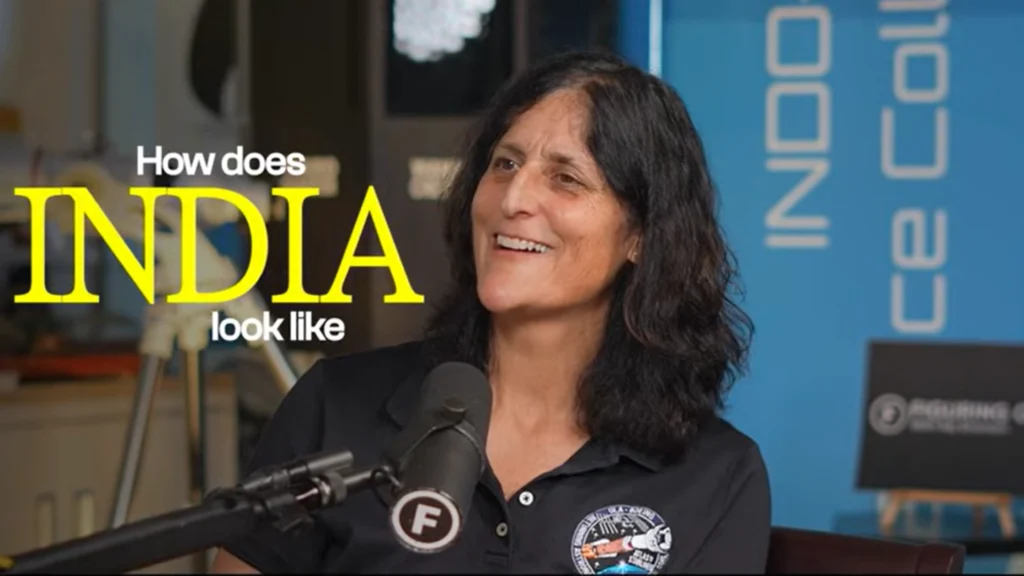
When Sunita Williams talks about India from space, her description feels closer to poetry than geography.
By day, India appears as an explosion of colour. Rivers trace visible paths across the land. The terrain tells stories. And the Himalayas, she says, stand out like nothing else on Earth, bold, unmistakable, almost unreal in their scale.
From orbit, geography stops being abstract. Patterns become visible. You understand why rivers flow where they do. Why civilisations grew around them. Why borders on maps suddenly feel artificial.
At night, however, India transforms completely.
Sunita describes the country as a glowing web of lights, deeply connected and unmistakably alive. Unlike sparsely lit regions elsewhere, India looks continuous, buzzing, awake. From space, there’s no doubt where human life thrives.
It’s a reminder that cities aren’t just infrastructure. They are energy. Movement. Collective presence. This dual view, colourful and quiet by day, electric and emotional by night, reframes how we think about home. Distance doesn’t reduce attachment. It sharpens it.
The emotional reality of space: Loneliness, bonds, and crying in zero gravity. Space travel often gets framed as heroic and technical. Sunita Williams gently dismantles that myth.
She speaks openly about loneliness. About missing people. About missing pets. And about the intense bonds astronauts form with crewmates, bonds that resemble family more than colleagues. When you’re orbiting Earth together, trust isn’t optional. It’s survival.
One of the most striking moments in the conversation is when she talks about crying in space.
In zero gravity, tears don’t fall. They pool. They cling to your eyes, forming liquid bubbles that blur vision. It’s uncomfortable, disorienting and deeply symbolic. Even something as basic as crying behaves differently when gravity disappears.
That moment captures the emotional cost of spaceflight perfectly. You can leave Earth, but you don’t leave being human behind.
Sunita also talks about vulnerability, about insecurity, and about the quiet mental strength required to function in an environment where the planet you love is always visible, but unreachable.
Returning to Earth
The journey doesn’t end when astronauts land back on Earth. In many ways, that’s when the hardest part begins.
In this exclusive interview with Raj Shamani, Sunita explains how the human body adapts to microgravity and how painful the readjustment can be. Nausea. Balance issues. Muscle weakness. A body that has forgotten how gravity feels.
Simple actions like standing, walking, or turning your head become challenges again.
This part of the conversation grounds space exploration in reality. It’s not just about launch and landing. It’s about recovery. Patience. And relearning how to live in your own body.
She also touches on questions many people are curious about. Does life exist beyond Earth? What does space smell like? What are the strangest things she’s seen in orbit that defy explanation?
Instead of dramatic claims, Sunita offers thoughtful honesty. Curiosity without certainty. Wonder without exaggeration.
Raj Shamani’s conversation with Sunita Williams is not a science lesson. It’s a perspective shift. Space, through her eyes, becomes a teacher. It teaches humility. It teaches connection. It teaches how fragile and precious Earth really is.
Seeing India from space doesn’t make it smaller. It makes it more meaningful. More interconnected. More alive.
And perhaps the biggest takeaway is this: no matter how far humans travel, what we carry with us isn’t technology alone. It’s emotion, memory, longing, and love for the blue planet below. To listen to the podcast, head to Raj Shamani’s YouTube channel ‘Figuring Out.’
Frequently Asked Questions
What does Sunita Williams say about India from space?
She describes India as vibrant and colourful by day, and as a glowing, interconnected network of lights at night, making it one of the most striking regions visible from orbit.
Can astronauts cry in space?
Yes, but tears don’t fall. In zero gravity, they form floating droplets that cling to the eyes, which can be uncomfortable.
Is space travel emotionally difficult?
Yes. Sunita speaks openly about loneliness, missing loved ones, and forming deep bonds with crewmates.
What happens to the body after returning from space?
Astronauts often experience nausea, balance issues, and muscle weakness as the body readjusts to gravity.
Does Sunita Williams believe in life beyond Earth?
She remains curious and open-minded, emphasising exploration and scientific discovery rather than certainty.